
Build a NSW Science Scope and Sequence with Dr Simon Crook in Stile
How would Dr Simon Crook use Stile to teach the new syllabus? In this session, Simon sits down with Chloe to create his ideal scope and sequence for the new syllabus in Stile.

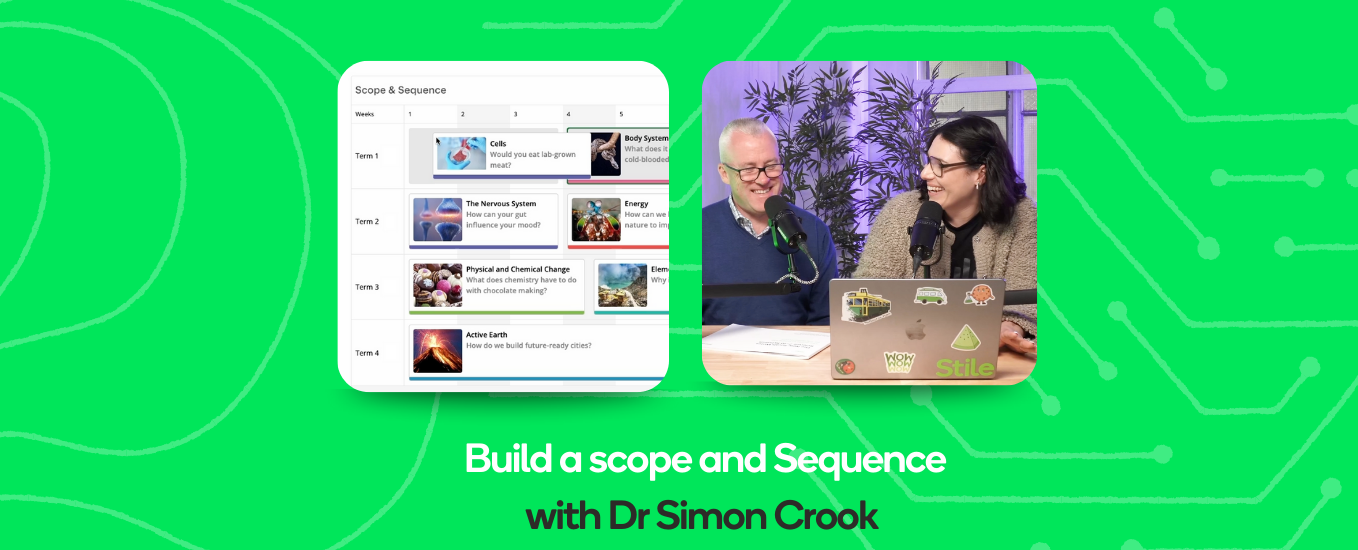
How would Dr Simon Crook use Stile to teach the new syllabus?
In this session, Simon sits down with Chloe to create his ideal scope and sequence for the new syllabus in Stile. It’s a great example of how you can use Stile as a world-class starting point to develop a science program tailored to your specific context, such as:
- Start from Stile’s syllabus-aligned sequence
- Rearrange units across the year to suit the needs of your school
- Adjust weeks and terms in a few clicks, without touching a spreadsheet
- Provide a shared program for your science team to draw from
Watch the full video here
Year 7 Key Takeaways
- Separating practice and theory makes for a clean entry point at the start of Year 7. Splitting Introduction to Science into the Practice of Science and the Nature of Science gives students time to settle into routines and equipment before exploring bigger concepts. It’s a simple shift that tightens the whole start of Year 7.
- The order of units shapes the feel of the year. Moving Mixtures, Forces, Magnetism, and Cells around within the year is about teaching logic, not paperwork. The Scope and Sequence Builder lets you drag, drop and tweak the length of units to create what makes sense for your context.
- You keep your professional judgement, Stile handles the structure. What you see in the video is not software making decisions. It’s an educator using Stile as the planning tool to shape a Year 7 program that feels coherent, teachable and ready to share with a whole department.
Year 8 Key Takeaways
- Data science works best when it’s woven in, not isolated. Stile threads Data science 1 throughout the Change focus area, rather than turning it into a standalone “data unit”. Simon calls out how natural this feels. You meet syllabus requirements without breaking the rhythm of the year.
- No need to over-engineer what already works. Year 8 lands neatly as is. Sometimes the most helpful insight is that a sequence already has strong pacing and coverage.
- It’s flexible if your team prefers a deeper integration. Simon notes that some schools will want a more “hybrid” approach to data science. Stile’s Scope and Sequence Builder supports that without you having to break anything or rebuild a term.
Year 9 Key Takeaways
- Depth studies are more powerful in context. Instead of tagging a depth study onto the end of a topic, Stile embeds it within the Energy unit. Students investigate something that actually matters to what they’re learning, not a disconnected task.
- The sequence already fits the syllabus without needing heavy adjustments. Year 9 comes together cleanly, despite it often being the hardest year to balance. Simon notes that while schools can move things for local reasons, the default order is strong as it is.
- Local tweaks stay simple. If your school has a preferred way to order Year 9, Stile supports minor modifications without rebuilding the whole year.
Year 10 Key Takeaways
- Waves and Motion deserves more time, and it gets it. Simon instantly notices that Stile stretches Waves and Motion across two terms. It’s a subtle design choice that supports deeper understanding and matches how many departments already teach it.
- Adjusting for term lengths, exam blocks or local scheduling is built. in Whether your terms are seven, nine or eleven weeks, or you need to create an exam block as its own placeholder, those changes take seconds. You can modify the structure without breaking alignment.
- Year 10 shows the value of a sequence that is both strong and flexible. The suggested pattern already works well, but you can still tune it to fit your school’s rhythm. It’s a balance that lets departments stay consistent while keeping autonomy.
Stile's ready-made resources for teachers and lab techs
Teaching Plans
Planning feels cohesive when everything sits in one place. Each Stile teaching plan shows weeks, sessions, big ideas, depth studies, equipment and learning outcomes all in one document and with a Word version ready for your school template.
Curriculum alignment is transparent. Every content statement and outcome is clearly tagged. Teachers don’t need to cross-check multiple documents to know what’s being taught where.
Lab Guides
Practical lessons become predictable and easy to prep. Equipment lists, visuals, instructions, demos and RiskAssess links live in one place. Teachers and lab techs know exactly what’s coming each week
Explore the 7–10 syllabus in Stile or book a short chat with a NSW curriculum specialist.
If your department would like a second pair of eyes on your current program, or you want to see how Stile has mapped focus areas, Data Science and Depth Study opportunities across Years 7 to 10, our team is happy to walk through it with you.
Chat with a NSW curriculum specialist.
About Dr Simon Crook
Dr. Simon Crook is the Director of CrookED Science and an Honorary Associate at the School of Physics, The University of Sydney. In 2015, he founded CrookED Science, a consultancy dedicated to enhancing science education through professional development for teachers and direct engagement with students, both in-person and online, across all school sectors (K-12). Simon is very keen to collaborate with educators, researchers, parents, administrators and science and technology organisations from all sectors.
Connect with Simon Crook and CrookED Science here