Building student confidence and study habits in science: A Stile classroom story
This article originally appeared in Observe, our every-so-often publication celebrating the craft and complexity of teaching science.

This article originally appeared in Observe, our every-so-often publication celebrating the craft and complexity of teaching science.
Campbell Wilson, was no stranger to the education trend cycle. Year after year, he relied on resources that had barely changed: textbooks. Feedback was meant to improve student learning, yet when your tools are locked between two covers, tailoring lessons to individual needs becomes nearly impossible.
“It’s like running on a treadmill,” he recalls. “You’re moving, but you’re not getting anywhere.”
The content was there, but students were left passively consuming information while Campbell spent hours trying to personalise feedback within a rigid system that offered little flexibility.
In 2020, he decided it was time for a change. He set aside the traditional textbook resources that had become more ritual than tool, and book-listed Stile as his school's core science curriculum.
It wasn’t an easy sell. Winning over his school’s leadership team required more than enthusiasm.
Price, however, wasn’t the real hurdle. The greater challenge lay in dismantling the belief that textbooks were the cornerstone of “real” teaching.
“It’s funny,” Campbell muses now, “how much of teaching is about convincing people to let go of what they’re used to. You’re not just changing resources. You’re challenging tradition.”
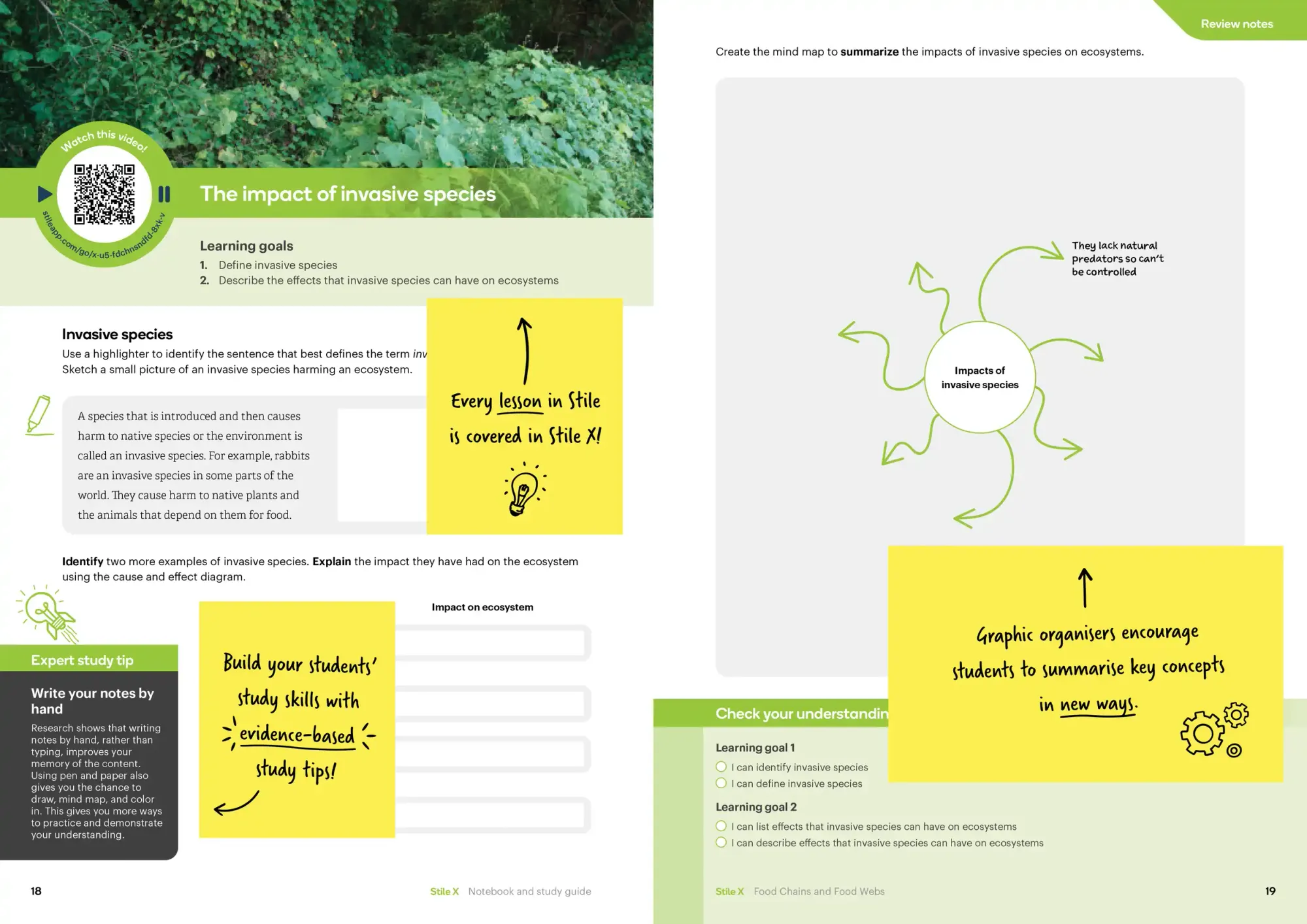
Gaining leadership’s support was only the first step. Once approved, Campbell introduced Stile gradually, beginning with practical shifts in how he delivered content. Stile X became the bridge. “We started using it for note-taking and revision,” he recalls, “but it quickly became more than that.”
What began as a supplementary tool soon became central to his classroom practice. Students moved fluidly between the Stile platform in class and Stile X activities at home, consolidating concepts through deliberate repetition and reflection.
What surprised Campbell most was not just the consistency. It was the depth of student thinking that began to emerge. Feedback stopped feeling like a chore. Stile’s Key and Challenge questions offered a clearer window into what students truly understood and where they were still struggling.“I wasn’t chasing after every detail anymore,” Campbell reflects. “I could focus on the questions that actually mattered.”
The endless cycle of vague responses and surface-level feedback gave way to clarity. For the first time, Campbell had access to sharp, actionable insights that let him meet students where they were. “Now, we can spend more time looking through students’ responses to Key and Challenge questions and really drill down into what they understand and what they don't,” he explains.
That shift gave Campbell something he hadn’t experienced in years: time.
He was no longer spending evenings and weekends deciphering ambiguous work or marking assessments that told him little. Stile’s structure freed him to do what mattered: engage with his students, address alternative conceptions in real time, and personalise learning without burning out.
“Stile gave me back time. I could finally focus on student understanding.”
“It wasn’t just about teaching more efficiently. It was about teaching better.” The results spoke for themselves. Students who used Stile consistently in Year 7 were performing at a higher standard by Year 8, demonstrating deeper conceptual understanding and stronger revision habits.
The most compelling indicator, however, came later.
In 2023, Campbell’s school recorded its largest-ever cohort of Year 11 Physics students. These weren’t just the usual “science learners” who had always gravitated towards the subject. They were students who had built confidence in their abilities over time. Given the tools to succeed, they chose to keep going.
“These are students who had used Stile through 2021 and again in Year 10 in 2022, where they really engaged with physics quite a lot,” Campbell observed. “That consistency enabled more learners to have the confidence to choose Year 11 Physics.” Stile didn’t just save Campbell time.
It gave him back control over how he used it. He shifted his focus from simply getting through content to meaningfully connecting with his students. This wasn’t about working harder. It was about working smarter and reclaiming the time that matters most.
Learn more about Stile X
As part of a complete program, Stile supports teachers to balance purposeful technology with meaningful screen-free learning. Stile X brings together five evidence-based strategies to help students consolidate and retain the core concepts of every lesson.