
Finding the sweet spot between explicit and inquiry
Finding the sweet spot between explicit and inquiry is an article that initially appeared in Observe.

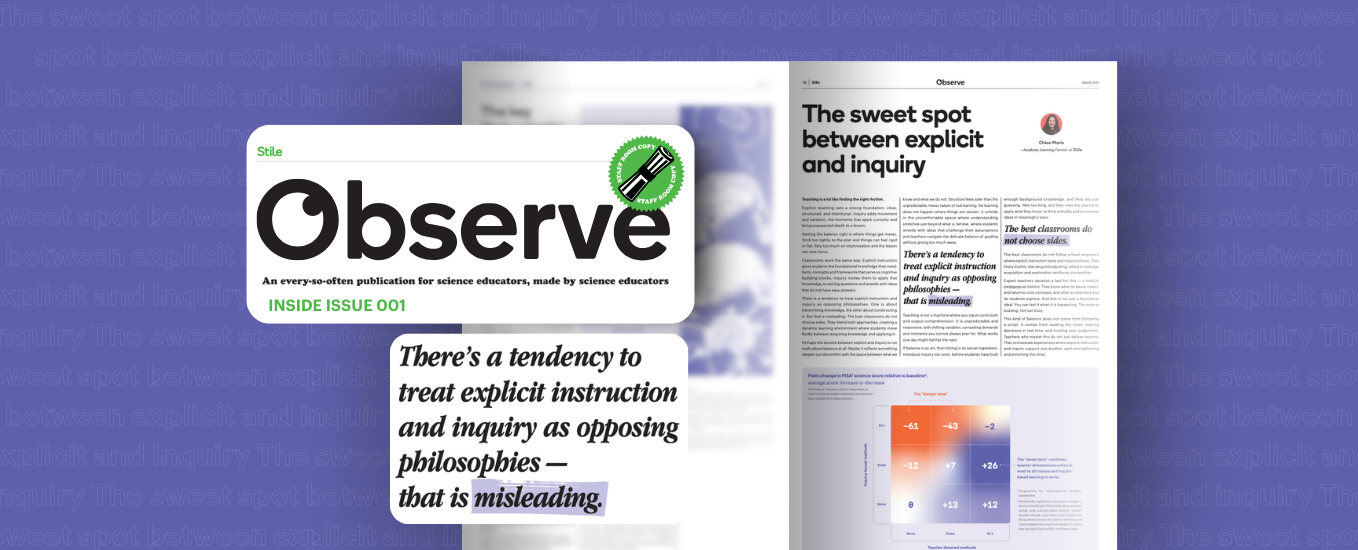
This article originally appeared in Observe, our every-so-often publication celebrating the craft and complexity of teaching science. In it, Stile’s Chloe Marie finds that 'sweet spot'.
Teaching is a lot like finding the right rhythm.
Explicit teaching sets a strong foundation: clear, structured, and intentional. Inquiry adds movement and variation, the moments that spark curiosity and bring unexpected depth to a lesson.
Getting the balance right is where things get messy. Stick too tightly to the plan and things can feel rigid or flat. Rely too much on improvisation and the lesson can lose focus.
Classrooms work the same way.
Explicit instruction gives students the foundational knowledge they need: facts, concepts and frameworks that serve as cognitive building blocks. Inquiry invites them to apply that knowledge, to ask big questions and wrestle with ideas that do not have easy answers.
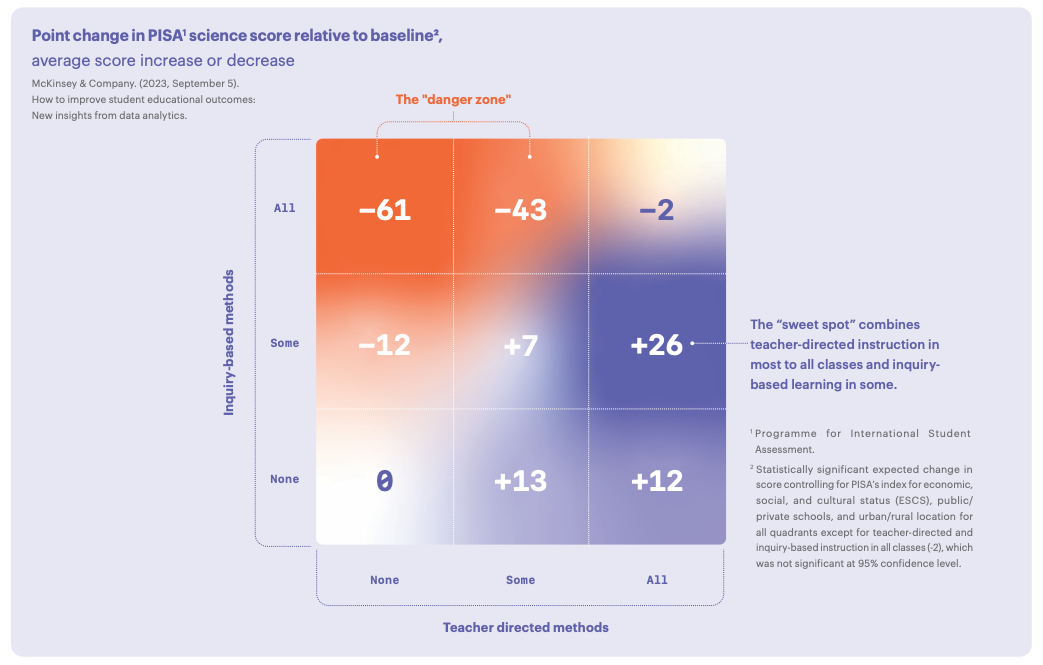
There is a tendency to treat explicit instruction and inquiry as opposing philosophies. One is about transmitting knowledge, the other about constructing it. But that is misleading. The best classrooms do not choose sides. They blend both approaches, creating a dynamic learning environment where students move fluidly between acquiring knowledge and applying it.
Perhaps this tension between explicit and inquiry is not really about balance at all. Maybe it reflects something deeper: our discomfort with the space between what we know and what we do not. Structure feels safer than the unpredictable, messy nature of real learning. Yet learning does not happen where things are certain. It unfolds in the uncomfortable space where understanding stretches just beyond what is familiar, where students wrestle with ideas that challenge their assumptions and teachers navigate the delicate balance of guiding without giving too much away.
Teaching is not a machine where you input curriculum and output comprehension. It is unpredictable and responsive, with shifting variables, competing demands and moments you cannot always plan for. What works one day might fall flat the next.
If balance is an art, then timing is its secret ingredient. Introduce inquiry too soon, before students have built enough background knowledge, and they are just guessing. Wait too long, and they miss the chance to apply what they know, to think critically and to connect ideas in meaningful ways.
The best classrooms do not choose sides.
The best classrooms do not follow a fixed sequence where explicit instruction leads and inquiry follows. They find a rhythm, blending and adjusting, where knowledge acquisition and exploration reinforce one another.
Expert teachers develop a feel for this — a kind of pedagogical instinct. They know when to pause inquiry and return to core concepts, and when to step back and let students explore. And this is not just a theoretical ideal. You can feel it when it is happening. The room is buzzing, not just busy.
This kind of balance does not come from following a script. It comes from reading the room, making decisions in real time, and trusting your judgement. Teachers who master this do not just deliver lessons. They orchestrate experiences where explicit instruction and inquiry support one another, each strengthening and enriching the other.
References
- Programme for International Student Assessment
- Statistically significant expected change in score controlling for PISA’s index for economic, social, and cultural status (ESCS) public/private schools, and urban/rural location for all quadrants except for teacher-directed and inquiry-based instruction in all classes (-2) which was significant at 95% confidence level.