
NSW Science 2026: What teachers need to know
Curriculum changes are challenging for all involved, especially teachers. We wanted to take the time to provide more clarity for our NSW educators to help them approach this big change for 2026.

The new NSW 7–10 Science syllabus is clearer, more structured, and in many ways more rigorous than what teachers have worked with before. With that clarity, though, has come a wave of misconceptions, particularly around sequencing, focus areas, Data Science and Depth Studies.
Curriculum changes are challenging for all involved, especially teachers. We wanted to take the time to provide more clarity for our NSW educators to help them approach this big change for 2026.
So Chloe Marie sat down with Dr Simon Crook, science education specialist and long-time advisor to NSW schools, for a practical conversation about what the syllabus actually requires. This blog shares the major insights from their discussion and includes direct explanations from the transcript to support department planning
Watch the full conversation here
The new NSW Science Syllabus: Everything teachers need to know [30 mins]
Focus areas do not have to fill one term each
One of the most persistent misconceptions about the comes from the graphic representation in the syllabus itself: 16 focus areas neatly set out in four sets of four. This has been interpreted as one focus area per term. It looks tidy. It looks prescriptive. It isn’t.
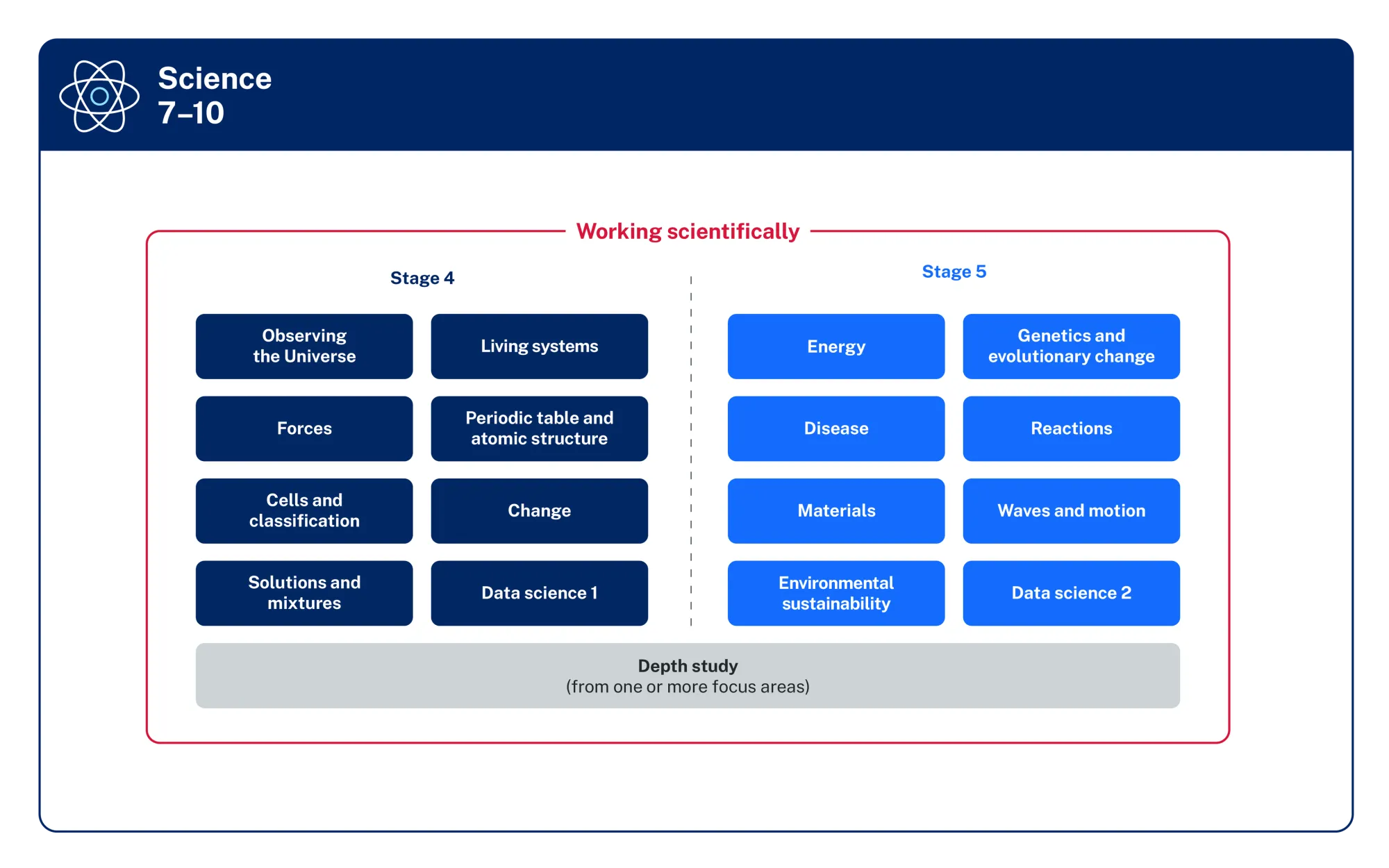
The graphic is a planning aid, not a timetable.
Its purpose is to give departments a guideline while everyone is still finding their feet. Many schools will follow it in the first year simply because it reduces cognitive load during a busy changeover. But the syllabus itself does not lock teachers into teaching one focus area per term, nor does it require the order shown.
The actual rule is far simpler: Stage 4 content goes in Stage 4. Stage 5 content goes in Stage 5. Everything else is up to professional judgment, localisation and the priorities of your classroom.
That autonomy is deliberate. Schools with limited laboratories might rotate classes through two different scope-and-sequence pathways. Others might pull a highly hands-on unit earlier in Year 7 to build confidence and practical skills. Some might reshuffle content based on teacher expertise, local programs, or opportunities for cross-curricular work.
Flexibility is built in because classrooms are not uniform. The syllabus acknowledges this. It expects teachers to adapt. It leaves room for sequencing that makes sense for your facilities, your timetable, and your students.
What matters is coherence across each stage, not rigid adherence to a term-by-term template.
Data Science does not have to sit in a big Term 4 block
Of all the new elements in the 7–10 syllabus, Data Science is the one generating the most curriculum anxiety and understandably so. It appears at the end of each stage in the syllabus’ graphic, which has led many teachers to assume it must be taught as a standalone, term-long unit in Year 8 and again in Year 10.
That assumption is incorrect.
The location of Data Science in this graphic illustrates one possible approach, not a required one. The syllabus explicitly allows for Data Science 1 and 2 to be taught as any of the following:
- as a dedicated unit
- integrated into another focus area
- embedded through existing investigations
- or delivered through a hybrid model that mixes these
This flexibility exists because Data Science is not a single skill set. It is a combination of ideas already woven into effective science teaching: working with models, evaluating representations, analysing patterns, collecting meaningful data, and making sense of uncertainty.
The intention is not to add an extra term’s work. The intention is to give students structured opportunities to build data literacy over time, regardless of where those lessons fall in the calendar.

In practice, this means departments have the freedom to design a version of Data Science that suits:
- the pacing of their existing program
- opportunities to connect with local phenomena
- the strengths of staff delivering the course
- the developmental readiness of each cohort
What matters is the cumulative experience across the stage. Whether Data Science sits neatly in Term 4 or appears in smaller, well-timed moments throughout the year, the syllabus supports both pathways as long as the core learning is covered meaningfully.
Depth Studies can be embedded, not added on top
Another area generating unnecessary pressure is the requirement for Depth Studies. On paper, “at least five hours per year level” can easily be interpreted as a large, separate assignment to construct, assess and justify on top of existing programs.
The syllabus does not intend this to be an add-on.
Depth Studies are simply extended opportunities for students to work more deeply with scientific ideas, skills and evidence. They can sit inside what you already teach. In fact, most schools are already doing work that fits comfortably within this requirement.
Depth Studies can take many forms:
- a practical investigation stretched over a few lessons
- a data-set analysis students return to across a unit
- a secondary-source inquiry connected to local context
- a fieldwork task brought to life through reflection and reporting
- a series of shorter, linked activities rather than one big project
There is no mandated format, no required report structure, and no expectation that schools adopt a substantial Student Research Project (SRP) style task unless they already find that model valuable.

For many departments, the most natural approach will be to embed Depth Study opportunities within existing units. A well-designed prac, an extended model evaluation, or a meaningful piece of fieldwork already creates the sustained engagement and higher-order thinking that Depth Studies are meant to represent.
Where schools have strong SRP traditions in Year 8 or Year 10, those tasks can continue. Where tasks feel outdated or onerous, the new syllabus offers permission to redesign them, not pressure to inflate them.
The goal is not to increase workload. The goal is to ensure students experience purposeful scientific thinking over time. When viewed this way, Depth Studies become a chance to refine what’s already working rather than build something entirely new.
Sequencing flexibility is built into the syllabus and encouraged
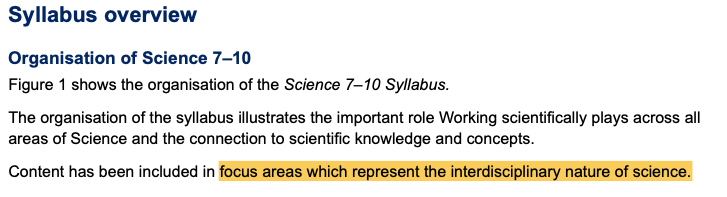
One of the most reassuring aspects of the new syllabus is the space it gives teachers to plan deliberately. Although the syllabus’s graphic representation is a tidy, linear path, the syllabus itself leaves room for schools to decide when and how content is introduced within each stage.
This flexibility is not a loophole. It is an intentional design choice.
NSW schools vary enormously in size, staffing, lab access, student need, and timetable structure. A centrally mandated sequence simply cannot account for that diversity, which is why the syllabus focuses on what must be taught at each stage rather than prescribing when it must be taught.
In practice, this gives departments scope to:
- reorder focus areas within Stage 4 or Stage 5
- adjust timing around lab availability or shared facilities
- run staggered pathways across a year group to reduce congestion
- build momentum through hands-on units earlier in the year
- cluster related concepts to support coherence and reduce load
What matters is that students experience a coherent, developmentally appropriate sequence across the stage. The order itself is up to the professional judgement of the department.

NESA’s guidance supports this: Stage 4 content must remain in Stage 4, and Stage 5 in Stage 5, but within those boundaries, schools are encouraged to plan in ways that reflect their local context. The syllabus provides structure, not rigidity.
For teachers, this means sequencing can be shaped by what will genuinely work for your students, not just what fits neatly into a predefined grid.
Where to from here
Syllabus change is always a mixed experience. There is a genuine opportunity in clearer outcomes and stronger progression, and there is also the very real work of rewriting programs, rethinking assessments and explaining it all to students and families.
The new Science syllabus does not remove that work. It does, however, offer more structure and more honest flexibility than many teachers have been led to believe. Focus areas are not locked to terms. Data Science does not need to be a late-year bolt-on. Depth Studies do not have to arrive as a whole new project. Within each stage, there is space for professional judgement, local context and the realities of your timetable.
The conversation between Chloe and Simon is intended to support that judgement, not replace it. It gives language you can take into your next faculty meeting, a shared understanding you can build into your scope and sequence, and a way to talk about the new course that feels steady.
Explore the 7–10 syllabus in Stile or book a short chat with a NSW curriculum specialist.
If your department would like a second pair of eyes on your current program, or you want to see how Stile has mapped focus areas, Data Science and Depth Study opportunities across Years 7 to 10, our team is happy to walk through it with you.
Chat with a NSW curriculum specialist.
About Dr Simon Crook
Dr. Simon Crook is the Director of CrookED Science and an Honorary Associate at the School of Physics, The University of Sydney. In 2015, he founded CrookED Science, a consultancy dedicated to enhancing science education through professional development for teachers and direct engagement with students, both in-person and online, across all school sectors (K-12). Simon is very keen to collaborate with educators, researchers, parents, administrators and science and technology organisations from all sectors.
If you would like to connect with Simon, Please visit crookedscience.com