
PISA science: a positive charge in a field of negatives
PISA 2025 results aren't all doom and gloom. Here's why we should be celebrating and congratulating Australian teachers, what we can take away from the results, and questions to discuss with your science team.

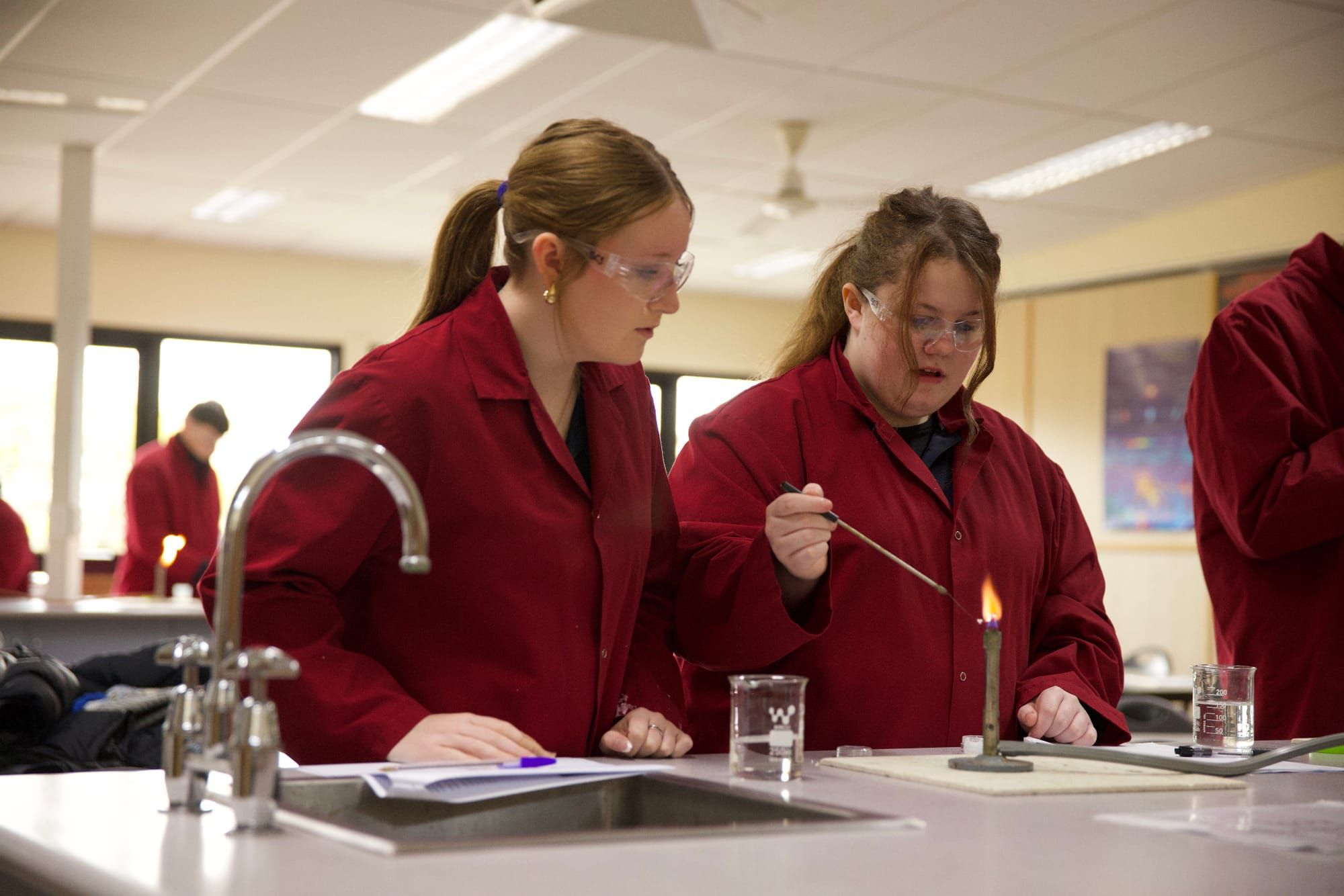
Australian science teachers have something worth celebrating in the PISA 2025 results.
Yes, reading and mathematics results have declined across the OECD, and our results have followed suit. We can’t ignore that, and we should be asking questions about it. But let's not forget that Australian students continue to perform above the OECD average in reading, mathematics and science.
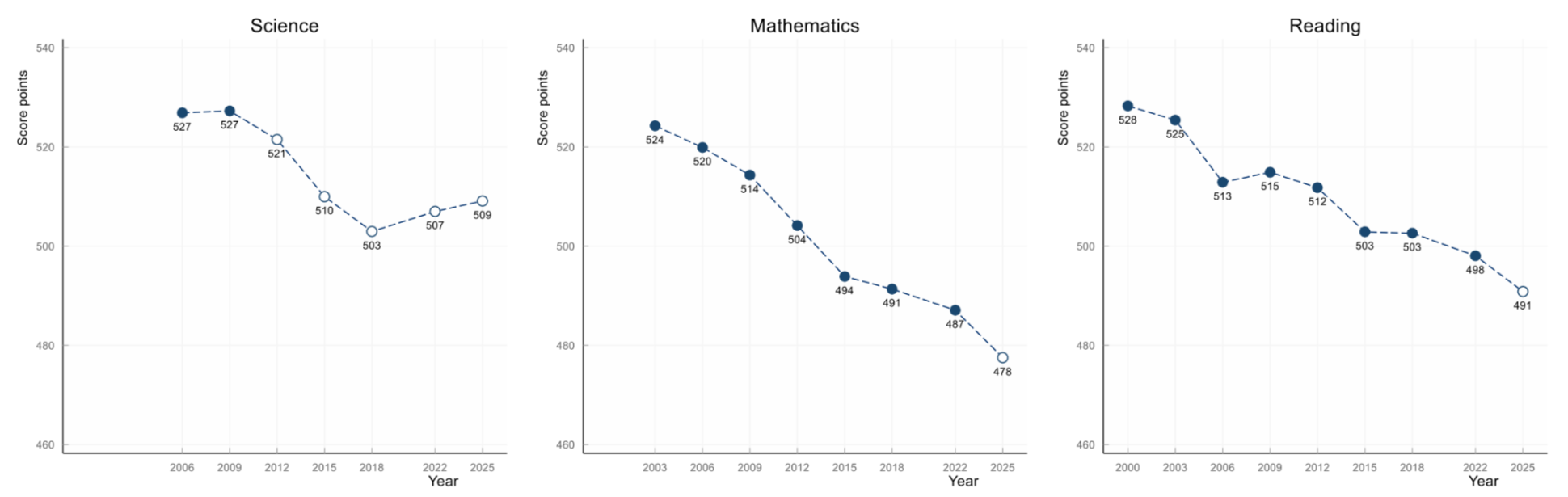
Something else that stands out: while reading and mathematics have declined over the past decade, science has remained remarkably stable. Something is going right in science. What is it? And how can we build on it?
Here are some other observations from examining the 2025 PISA results along with discussion questions you can use in your next department meeting.
We need to celebrate Australian science teachers
Science is a real bright spot in Australia’s PISA results, and the student survey gives us good reason to recognise Australian science teachers.
In 2025, 82% of Australian students reached at least Level 2 in science, compared with a 74% OECD average. 12% were top performers, compared with the OECD average of 7%.
Student survey results are even more encouraging. Compared with the OECD average, more Australian students say their science teacher:
- Shows an interest in every student’s learning (79% vs 69%)
- Continues teaching until students understand (73% vs 66%)
- Gives extra help when students need it (80% vs 73%)
These responses reflect the care Australian science teachers bring to their work. Translation: Australian science teachers are bloody awesome. We’re incredibly proud to have worked with so many Australian schools in the last thirteen years, supporting you to do what you do best.
Discuss: What do you do that might make your students say “My teacher notices whether I’m learning and keeps helping until I understand”?
What else is happening outside of school?
Much of the discussion about falling PISA scores is focused on the education system. The scale of decline suggests a wider influence. Between 2018 and 2025, three quarters of participating countries showed a significant drop in reading performance, and only 5 countries showed an improvement.
Reading habits Both enjoyment of reading and time spent reading are at record lows in young people. Instead, they tend to consume information in digital environments that encourage rapid scanning and switching over in-depth analysis. According to PISA, the proportion of students classified as “hasty” readers, who move quickly through a text and arrive at incorrect answers, has doubled since 2018.
What about sustained attention? Students are also growing up in a world of short-form entertainment, instant information, and tools that remove effort from difficult tasks. They have fewer opportunities to apply focus to a task, like reading a long text closely or working through a complex problem. PISA is assessed through a two-hour exam. Students’ performance consistently declines as the exam goes on. Are students’ results falling because of a reduced ability to sustain focus?
Discuss: Where in our science program do students have to slow down, read closely and persist with something difficult?
Literacy and numeracy are science business
Falling reading and maths results will mean a greater focus on literacy and numeracy in Australian schools. That might feel like a problem for English and Maths departments to tackle, but science educators have an important role to play too.
Unpacking scientific vocabulary, reading explanations, identifying claims and evidence, interpreting data, taking measurements and making calculations are all part of thinking scientifically.
You don't have to squeeze extra literacy and numeracy tasks into a crowded lesson plan. You can make the science-specific applications of reading and maths within your lessons more explicit and visible.
Discuss: Where are students already reading and reasoning mathematically in your science classes? How can you emphasise those moments?
It’s not about screens. It’s about how they’re being used
PISA 2025 adds useful nuance to the screen time debate.
Moderate use of digital devices for learning is associated with stronger science performance than either no use or very high use. When devices are used for leisure at school for longer than an hour each day, there is a negative association with science performance.
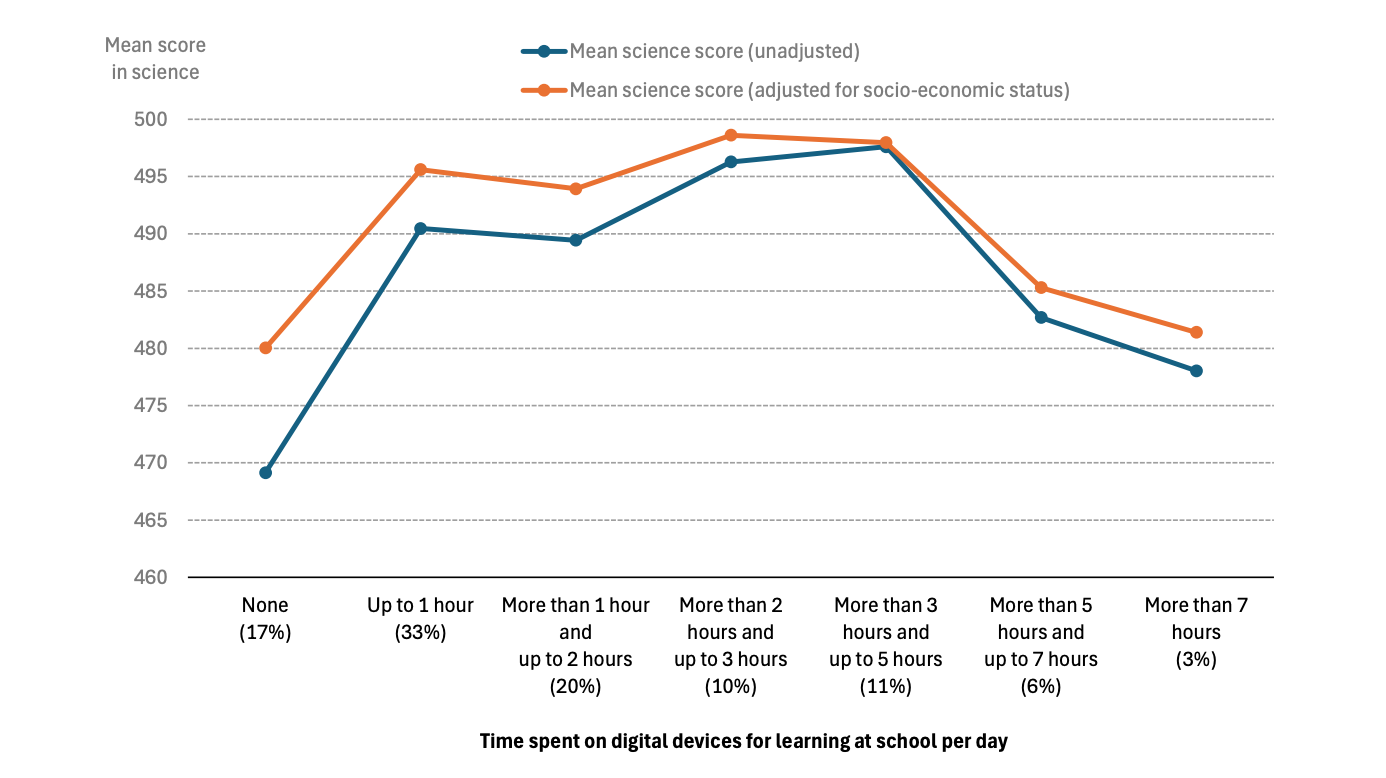
That makes sense. Watching a simulation, collecting experimental data and answering a formative question are very different from scrolling social media or playing games. The most useful question for teachers isn’t “How much time should we be spending on screens?” but “When does technology enhance learning?”
The OECD concludes that digital tools can support learning when used with purpose and in moderation, while excessive or unguided use risks distraction and shallower engagement.
Discuss: What does purposeful use of digital devices look like? When does technology support learning, and when is something else better?
AI should help students think, not do the thinking for them
Half of Australian students say they use AI chatbots at least weekly to help them learn.
PISA suggests the relationship between AI use and achievement is complicated. Students who use AI for tasks such as summarising, research or drafting tend to score lower in science than students who don’t. But moderate AI use “to help me learn” is associated with stronger performance than very frequent use.
These correlations raise an important question: Is AI helping students think, or helping them avoid thinking?
AI can be a powerful learning tool, but if it does the explaining, reasoning or summarising for the student, it takes the thinking work out of it. The work is what leads to learning.
Discuss: In which science tasks could AI enhance student learning, and which ones do students need to do themselves?
So, what can we take away from PISA 2025?
PISA can’t tell us everything about how we should teach science, or why it’s been more resilient than reading and mathematics, but it gives us some helpful information.
Science has held steady while reading and mathematics have declined. Students report strong support from science teachers. Literacy and numeracy play an essential role in scientific thinking. Purposeful use of technology looks very different from digital distraction. And, in an age of AI, students still need opportunities to wrestle with the cognitive work of learning.
These PISA results carry a positive charge and give Australian science teachers something to celebrate. The challenge now is to protect what’s working and keep improving Australian science education.
References and further reading
De Bortoli, L., Underwood, C., & Bertling, J. (2026). PISA 2025: Reporting Australia’s results. Volume I: Student performance. Australian Council for Educational Research. https://doi.org/10.37517/978-1-74286-810-3
De Bortoli, L., & Underwood, C. (2026). PISA in Brief Australia 2025: Student performance. Australian Council for Educational Research. https://doi.org/10.37517/978-1-74286-811-0
De Bortoli, L., & Underwood, C. (2026). PISA 2025: A first look at student and school characteristics. Australian Council for Educational Research. https://doi.org/10.37517/978-1-74286-812-7
OECD. (2026). PISA 2025 Results (Volume I): Future-Ready Students. PISA, OECD Publishing. https://doi.org/10.1787/73451bc5-en
OECD (2026), "Australia", in PISA 2025 Results (Volume I): Country Notes, OECD Publishing