
Supporting literacy in science with Stile X
This blog outlines key strategies embedded in Stile X that directly support a school-wide focus on literacy.


Science places a high level of demand on students' reading and writing skills. We expect them to understand and apply subject-specific vocabulary, interpret diagrams and structure evidence-based explanations.
Stile X is designed so students practise reading and writing while learning scientific content. Below are some of the specific literacy strategies that are built in.
Strategy 1: Direct Activities Related to Text (DARTs)
Stile X scaffolds students to create their own revision notes for each Stile lesson and supports their understanding of key concepts and terminology. Rather than traditional ‘comprehension’ questions, students complete Direct Activities Related to Text (DARTs). These strategies for processing texts, developed by Lunzer and Gardner in the 1970s and 1980s, encourage learners to engage with texts in ways that promote deeper understanding.
Examples of DARTs in Stile X
Text completion activities
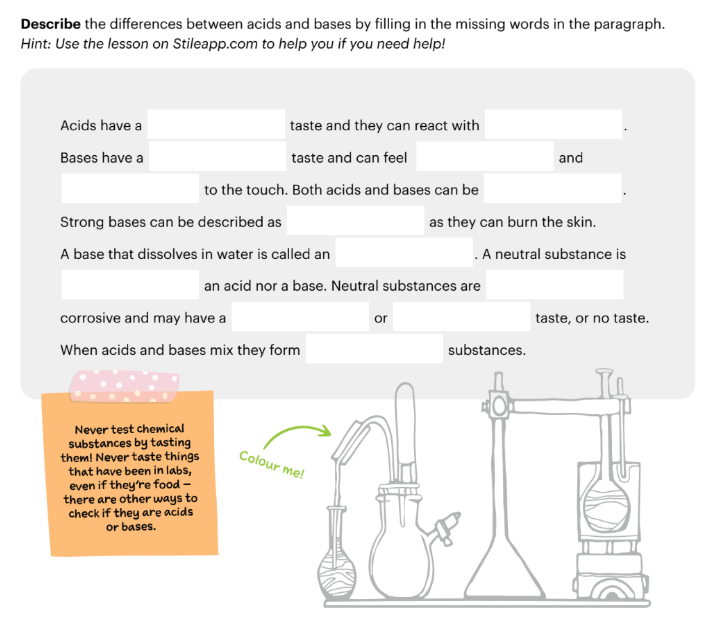
Text completion activities model sentence construction, language structures, and vocabulary for students to use.
There are various types:
- Sentence starters: where learners are given the first word, or first few words, of a sentence
- Sentence frames: where learners are provided with useful structures with gaps for them to complete
- Paragraph starts: give learners the first few words of each paragraph to scaffold extended pieces of writing
Stile X includes a range of differentiated frames, from those where students complete sentences with vocabulary from a word bank, through to more open-ended ones that reduce scaffolding.

Underlining or highlighting particular sections of text
Students use a key to annotate scientific text. The annotation key provides explicit scaffolding that helps students draw out key information from texts.

Visual cues
Through Stile X, students learn a range of note-taking methods from Years 7 to 10, which grow in complexity from two-column notes to more advanced Cornell notes. As the note-taking process is scaffolded, activities directly teach students to break text into smaller chunks and create headings or ‘cues’ for each section. Students can be encouraged to use visual cues or, for speakers of other languages, cues that include words from their home language to help them recall information later.

Strategy 2: Flashcards
Every Stile unit has a set of printable flashcards and an interactive glossary quiz. These work well for introducing, memorising, revising and consolidating vocabulary. Research with English language learners suggests that revisiting vocabulary supports acquisition (Schmitt 2008), and flashcards give learners more opportunities to encounter target words and phrases. Pairing words with pictures that students recognise provides context that helps them connect to prior knowledge.
Strategy 3: Vocabulary games
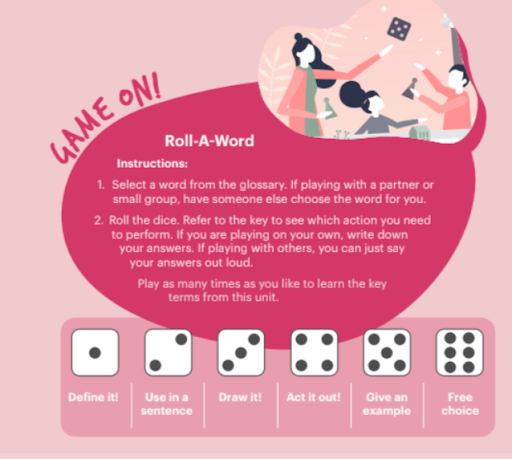
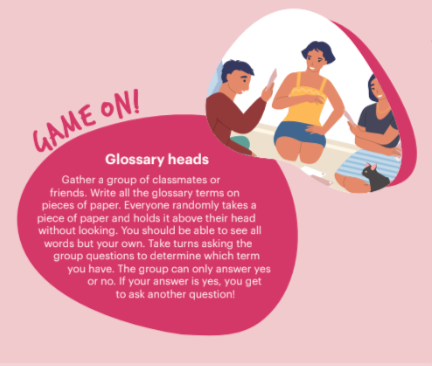
The glossary in each Stile X booklet provides students with a range of vocabulary games that can enhance their motivation, ability to memorise words and use them in context. Collaborative group work provides real opportunities for communication, which many researchers say is important for language development, including Michael Halliday, Neil Mercer and Mikhail Bakhtin. Gardner (2012) argues that collaborative learning is a feature of inclusive classrooms, and Cordon (2000) also supports the benefits of group work. Kotler et al. (2001) highlight the importance of social interaction and active participation in language acquisition.
Strategy 4: Graphic organisers
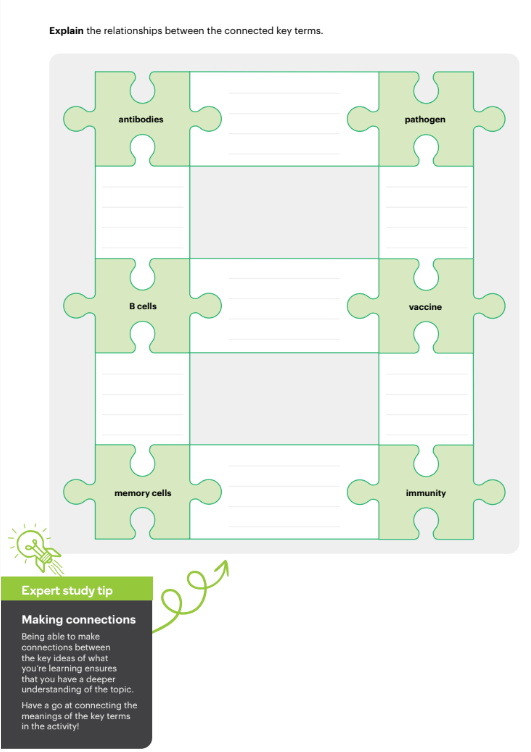
Graphic organisers such as Venn diagrams, concept maps, and timelines show connections and relationships between different concepts visually and nonverbally. They are excellent for keeping a task cognitively challenging while keeping the language accessible.
Graphic organisers allow students to organise their thoughts before expressing them in written text.

The Frayer Model is a graphic organiser for building student vocabulary. This technique requires students to define target vocabulary and apply their knowledge by generating examples and non-examples, giving characteristics, and/or drawing a picture to illustrate the word's meaning. The purpose of the Frayer Model strategy (Frayer, Frederick and Klausmeier, 1969) is to define and categorise a concept, leading to a deeper level of understanding.
Frayer models are embedded throughout Stile X to encourage deep understanding of key words and terms while drawing on students' prior knowledge and experiences.
Examples of Frayer Models used in Stile X:

Supporting students who are learning English
Research shows that using a student’s home language can help them build new language and understanding of content (Cummins, 1996, p. 147; Adam & Harper, 2016). Answering and asking questions in multiple languages supports concept and vocabulary development for students with EAL (Hardman, 1999), as does labelling vocabulary in their home language (Schwinge, 2003).
Encourage English language learners to complete Stile X activities in their home language. This gives them an opportunity to activate prior knowledge and transfer content, linguistic knowledge and academic skills between their languages.
Stile X and a whole-school literacy focus
In the science classroom, students read dense texts and construct explanations. It's the perfect place to support a whole-school literacy focus. Stile X gives your team the tools to do that through built-in writing scaffolds and vocabulary activities.
Keen to learn more about Stile X?
Contact community@stileeducation.com to chat with a team member about how Stile X could support your school's literacy goals.
Learn more about Stile's revision and mastery resources here or read about the evidence-based learning strategies embedded in Stile X's design and content here.