
Purposeful by design: What A Digital Detox means for Australian science classrooms
Education Ministers believe that technology in schools should be evidence-based and purposeful. We couldn't agree more.

The Australian Government recently released A Digital Detox, a national paper on screen use in schools. Education Ministers believe that technology in schools should be evidence-based and purposeful. We couldn't agree more.
A common-sense response
Australia's focus has shifted from investing heavily in technology in schools to thinking carefully about how it is used. Education Minister Jason Clare says, "I'm not against technology in schools. Students still need to learn digital skills, but there is an argument to wind it back a bit."
The paper's central principle is one we believe wholeheartedly:
"Technology must serve a clear educational purpose and be aligned with teaching and curriculum in order to strengthen rather than replace effective teaching..."
These are the principles around which Stile has been built since 2013: a science program that supports teachers to teach, with students using technology when it helps them to learn.
What the paper says
The paper summarises research on device use and AI in schools. There were two clear take-home messages for me:
Distraction is a real problem. In PISA 2025, 39% of Australian students said their classmates are often distracted by devices in most or all science lessons, compared with 28% across the OECD. Australian students also spend more time on devices at school, about 2.6 hours a day against an OECD average of 1.7, which may help explain the higher levels of distraction. It's not surprising that teachers are tired of competing with games, videos and messaging for students' attention.
Purposeful use is still valuable. The paper warns against excessive, unfocused use of devices in schools. It draws on the OECD’s finding that moderate device use for learning is linked to better results than either no use or heavy use. In PISA 2025, students whose recreational device use was no more than an hour during the school day scored 72 points higher in science than peers whose equivalent use was between five and seven hours. Across these studies, the clearest negative evidence relates to students using devices for leisure during school time.
What purposeful looks like in a science lesson
"Purposeful" is the word of the moment. Puentedura's SAMR model, while criticised for several reasons, offers a simple test. If devices are being used to directly substitute for an off-screen activity, we're probably better off keeping it off-screen. At the other end of the scale, when a device means students can engage in learning tasks that wouldn't otherwise be possible, we should take advantage of that opportunity.
An example of substitution is note-taking. In this case, the laptop is a direct swap for pen and paper, and there's evidence that handwriting supports memory, which makes it better suited to taking notes. With exceptions for specific learning needs, this suggests students should take notes by hand.
Some science learning is enhanced by a device. For example, a simulation lets students easily manipulate variables and observe changes that are too slow or too small to see in a school lab. Digital tools like this have been found to support secondary science learning, and research suggests they can build conceptual understanding as well as hands-on experiments. This is a redefinition, and the presence of the device is justified.
There's evidence that many Australian teachers already take this purposeful approach. Researchers funded by the NSW Government observed 68 classrooms in 2025 and found that students weren't using devices almost half the time. The first recommendation made by this research is to trust teachers' professional judgement about when screens add to a lesson. Read how we've unpacked what the NSW research tells us about screens in classrooms.
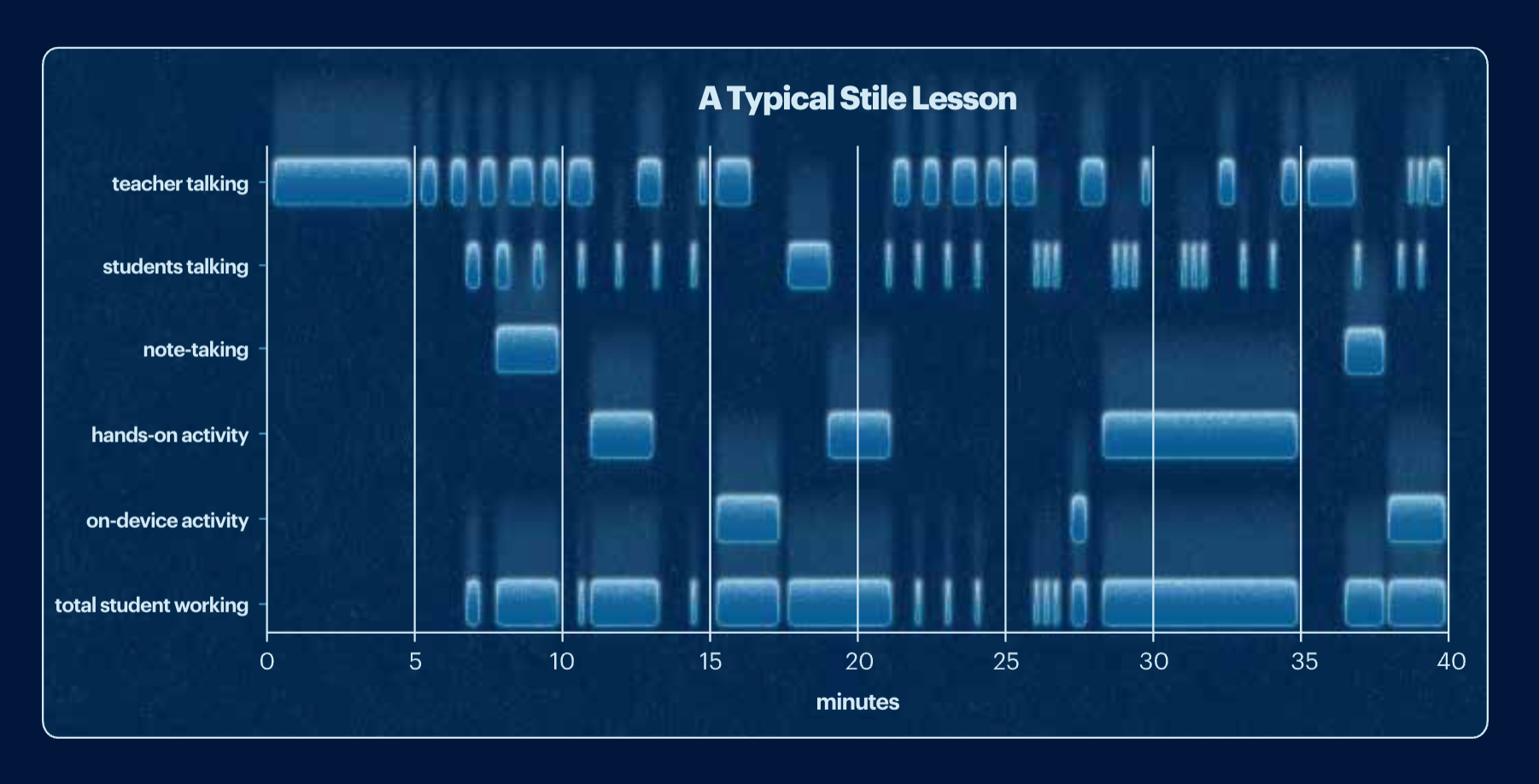
We saw it for ourselves when we sat in on a 40-minute Year 10 genetics lesson taught with Stile. Students were on their devices for about 5 minutes. For the rest of the lesson, the teacher led from the front with the lesson projected, and students talked through ideas and took notes on paper between hands-on tasks.
What we're doing
Over the past year, we've heard your feedback and have made it easier to use the combination of practical, print and purposeful technology that works best for you and your students:
- Labs and hands-on activities are now fully offline. A printed handout gives students everything they need to complete a practical activity, including the method and essential safety messages.
- Whole units print as booklets, with writing space suited to the expected answer for each question.
- Screen-free Engagement Strategies, like Value Line and Whiteboard Wipeout, are built into lessons to support active, off-screen learning.
- Early next year, a new slide mode will turn any Stile lesson into a slide presentation, offering lesson content in a format that supports explicit instruction by breaking information into small, manageable chunks while integrating helpful Teach Mode tools.
Evidence is the right standard
Ministers have asked for evidence, and that's the right standard for everyone, including us.
We'd like to see an independent body that rates educational resources against the evidence, so schools can compare quality using unbiased information. When it exists, we'll put Stile forward to be rated. Read more about why schools deserve evidence. We also welcome the chance to contribute to the Digital Detox Taskforce as it consults with schools and industry.
The decision belongs with schools
Above all else, we believe the "right" approach to using technology will look different between classes, schools and year levels. Your professional judgement puts you in the best place to decide when to use screens. Our job is to make it easy for you to teach well with Stile, whether that's on-screen or off.
If you'd like to talk about how Stile can support purposeful technology use in your science program, our team is happy to help.